Relationship structures explained
If you're new to non-monogamy, the number of terms can feel overwhelming. Triads, Vs, polycules, solo poly, relationship anarchy — it sounds like you need a glossary before you can have a conversation.
The good news: these aren't complicated concepts. They're descriptions of different relationship shapes. None of them are inherently better or worse than the others. They're different configurations that work for different people.
Here's what each one actually means.
The big categories
Before getting into specific shapes, it helps to understand three broad categories that often get mixed up. Confusing them is one of the biggest sources of miscommunication in online discussions about non-monogamy.
Swinging
Swinging focuses on recreational sexual experiences with others, typically as a couple. The emotional center of the relationship stays between the original partners. Connections with others are primarily sexual and often situational: parties, clubs, apps designed for the purpose. The expectation is usually that encounters are shared experiences, not separate romantic relationships.
Polyamory
Polyamory involves having multiple romantic relationships with the knowledge and consent of everyone involved. The word means "many loves." Unlike swinging, the emphasis is on emotional and romantic connections, not just sexual ones. Polyamorous relationships can take many shapes, and the rest of this page covers the common ones.
Open relationships
"Open relationship" is a broader umbrella that can include elements of both. It generally means a committed relationship where one or both partners can pursue connections with others, with agreed-upon boundaries. The specifics vary widely: some allow casual sex but not romance, some allow romance, some have detailed agreements about frequency and disclosure.
Why this distinction matters
A couple looking for a casual sexual encounter is doing something fundamentally different from a couple looking to build a life with a new partner. The expectations, risks, communication needs, and ethical considerations are different. When people argue about "unicorn hunting" or "dating as a couple" without specifying which context they're in, the conversation breaks down fast, because the same label is covering situations that have almost nothing in common.
Relationship shapes
These describe who is connected to whom — the geometry of the relationship.
Dyad
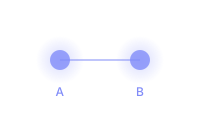
Two people in a romantic and/or sexual relationship. This is the simplest unit. Multi-person relationships contain dyads — a triad has up to three, a quad has up to six — but that doesn't mean the dyads are the whole story. Some triads function primarily as a group, some develop strong individual connections between each pair, and most are a mix. The dyad matters as a concept because it helps people think about the different connections within a larger dynamic, but it's a lens, not a formula.
Vee (V)
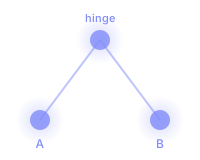
Three people where one person (the hinge or pivot) is romantically involved with two others, but those two are not romantically involved with each other. Named after the shape of the letter V.
The two people who aren't dating each other are called metamours. How metamours relate to each other varies widely. Some become close friends. Some prefer minimal contact. Some eventually develop their own connection and the V becomes a triad. All of these are fine.
Triad (throuple)
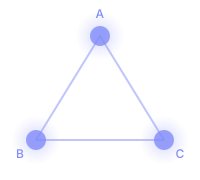
Three people who are all romantically and/or sexually involved with each other. Sometimes called a throuple in casual use. A triad can contain individual connections between each pair (A-B, B-C, A-C), a group dynamic, or both — but the group dynamic is usually the reason people want a triad in the first place. Some triads develop strong one-on-one connections alongside the group. Others function primarily as a unit. What matters is that everyone's needs are met, not that the internal structure matches a specific model.
Triads can be open (members may also have partners outside the triad) or closed (all three agree to be exclusive to each other). A closed triad is sometimes called polyfidelity, a recognized relationship structure in both community practice and academic literature.
Triads form in different ways. Some start when a couple meets someone new — a process sometimes called poly convergence. Some form when three people meet independently. Some happen accidentally: friends develop feelings, or a Vee evolves over time. The origin story doesn't determine whether the relationship is healthy. The behavior inside it does.
Quad
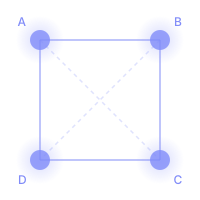
Four people who are intimately connected. Quads can take many forms: two couples where everyone is involved with everyone, a square where each person is connected to two others, or various other configurations. The defining feature is four people with romantic links between them, though not necessarily every possible pairing.
Polycule
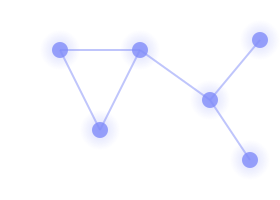
Not a specific structure but a term for the entire network of interconnected relationships. Your polycule includes your partners, their partners, those partners' partners, and so on. Think of it as a relationship map or constellation. Polycules can contain any combination of dyads, Vs, triads, quads, and other shapes.
The landscape
The shapes above describe who's connected to whom. But relationships also differ in two other ways that don't always line up with the shape: how exclusive the arrangement is (closed to the group, or open to outside connections) and how intertwined daily life becomes (shared home and finances, or deliberately independent lives).
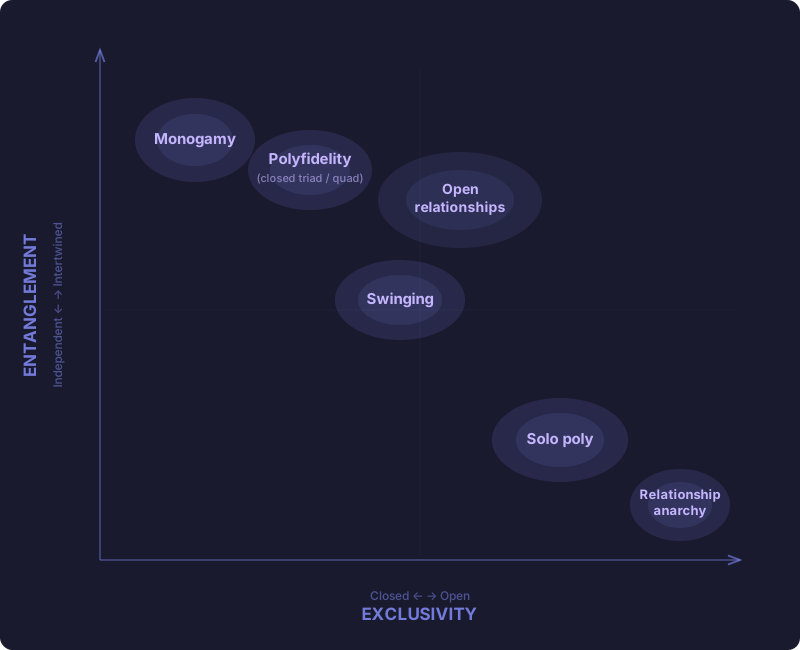
This is a small sampling to show the spread, not a comprehensive map. Polygamy, BDSM dynamics, casual dating, culturally specific relationship traditions, and countless individual variations aren't shown here. The real landscape is wider than any chart can capture.
Notice where monogamy and polyfidelity land — right next to each other. They share the same core values: commitment, exclusivity, building a life together. The only difference is the number of people. That's not an accident. For people exploring closed triads, what they're doing is closer to what they already know than the internet usually suggests.
The map also shows why the 1D "monogamy vs. polyamory" spectrum doesn't capture reality. Solo poly and polyfidelity are both non-monogamous, but they have almost nothing in common in how daily life actually works. The shape of the relationship and the philosophy behind it are separate variables.
These positions aren't fixed. People move around this map over time: a solo poly person might eventually nest with a partner, a hierarchical couple might move toward non-hierarchy as trust builds, a closed triad might open up after a few years of stability. The map describes where someone is now, not where they'll always be.
Approaches and philosophies
These describe how people practice non-monogamy — not who's connected to whom, but the principles and preferences that shape how those connections work.
Solo polyamory
A person who maintains multiple romantic relationships but doesn't pursue traditional relationship milestones with any partner: cohabitation, shared finances, legal marriage, or merging daily lives. Solo poly people consider themselves their own "primary partner." This isn't about being commitment-averse; it's a deliberate choice to maintain independence while still having deep, meaningful relationships.
Hierarchical polyamory
A structure where relationships are explicitly ranked. A primary partner (often a spouse or long-term cohabiting partner) gets the most time, resources, and input into major decisions. Secondary partners get less. Some hierarchical structures include veto power, where a primary partner can end or limit a secondary relationship — see that page for why this tends to cause problems.
Hierarchy can be descriptive (acknowledging that some relationships naturally involve more entanglement due to shared housing, children, or years of history) or prescriptive (actively enforcing rules that keep secondary partners in a lower tier). The descriptive kind is almost unavoidable in practice. The prescriptive kind is where ethical concerns tend to come up.
Non-hierarchical polyamory
No relationship is formally ranked above another. Each relationship develops on its own terms, and every partner is considered when making significant decisions. This doesn't mean all relationships look identical — they'll naturally differ based on time, logistics, and what each connection involves. It means no relationship is structurally subordinated by design.
Relationship anarchy
Based on Andie Nordgren's 2006 manifesto, relationship anarchy rejects the idea that relationships should be ranked by type. Romantic relationships aren't automatically more important than friendships. Sexual relationships aren't automatically more important than non-sexual ones. Each relationship is unique, and the people in it decide what it looks like, free from societal scripts about what relationships are "supposed" to be.
Relationship anarchists often avoid labels like "primary" and "secondary" entirely, and may not draw hard lines between friendship and romance.
Kitchen table vs. parallel polyamory
These describe how a person's multiple relationships interact with each other, not the relationships themselves:
-
Kitchen table polyamory — Everyone is comfortable being together. Partners and metamours can share meals, hang out, coexist. It doesn't mean everyone is best friends, but there's openness and ease.
-
Parallel polyamory — Partners know about each other but interact minimally or not at all. Each relationship exists on its own track.
Neither approach is more "evolved" than the other. Some people thrive with kitchen table dynamics. Some need more separation. Many land somewhere in between, and preferences can change over time.
A note on labels
These categories are tools for communication, not boxes to live in. Most real relationships don't fit neatly into one label. A triad might practice some hierarchy in practical terms while rejecting it philosophically. A solo poly person might eventually choose to nest with a partner. A V might become a triad, or a triad might become a V.
The labels are useful for describing what's happening right now. They're less useful as identities to defend. If you find yourself arguing about whether your relationship "counts" as a particular structure, you're probably spending energy on the wrong thing.
What matters isn't the label. It's whether the people involved are being treated well.
Related reading
- Terminology and language guide — Deeper dive into the words used in non-monogamous spaces and why some are loaded
- Getting started with non-monogamy — Orientation for people who are completely new
- Stigma, Myths & Criticism — Claims about specific structures examined against what we actually know